

Introduction
Connect your Shopify operation to TOTVS ERPs with an architecture designed to reduce rework, organize orders, and provide greater visibility into the operational flow.
Why integrate Shopify with TOTVS
Shopify focuses on the sales front end and customer experience. TOTVS focuses on operations, back office, and business management. When the two systems do not communicate, the team wastes time on manual entries, information discrepancies, and rework.
With the integration, you create a bridge between sales and operations, allowing data to flow in a structured manner between the two ends of the process.
How the architecture works
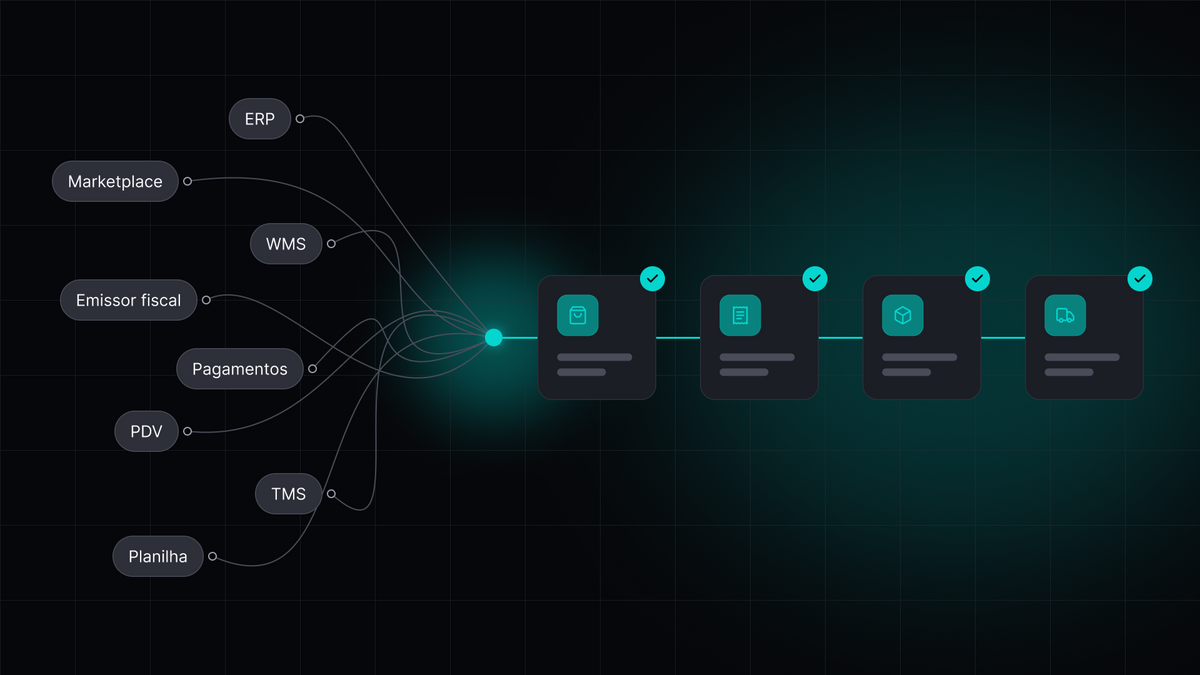
The integration architecture may vary depending on the operation, but the principle is the same: Shopify remains the commerce channel, while TOTVS begins to receive and send data according to the business rules.
In a typical structure, the integration may include:
- Orders: sending orders from Shopify to TOTVS
- Customers: synchronizing registration data
- Products and prices: updating items, variations, and price lists according to the defined rule
- Inventory: aligning availability between systems
- Order status: returning operational information to the store
- Notes and invoicing: supporting the tax and operational flow, where applicable
The exact definition depends on the TOTVS version, existing integrations, and the maturity of the internal process.
Benefits of integrating Shopify with TOTVS
Less manual work
Reduce duplicate entries and operational tasks that consume the team's time.
More consistent data
Reducing discrepancies between the store, ERP, and operations improves information reliability.
More organized operation
With integrated systems, the flow between sales, picking, invoicing, and shipping becomes clearer.
Better scalability
The integration helps support growth without relying on a proportional increase in manual effort.
More visibility
The company gains better visibility into what happened with the order, inventory, and back office.
Who this integration makes sense for
This integration is usually recommended for operations that:
- sell on Shopify and use TOTVS as their ERP
- need to reduce manual processes
- handle a significant volume of orders
- need to better organize inventory, registration, and invoicing
- want to structure growth without losing operational control
FAQ
Is the integration native?
It depends on the stack used. In many cases, the integration is custom-built or supported by middleware such as TOTVS IPaaS and Check's OMS, depending on the operation's architecture.
What can be synchronized?
The most common flows involve orders, customers, products, inventory, and operational status. The final scope should be defined on a case-by-case basis.
Is the integration compatible with any TOTVS?
Not necessarily. Compatibility depends on the TOTVS product used, the version, and the available APIs or mechanisms.
Do I need to replace the ERP?
No. The purpose of the integration is precisely to connect Shopify and TOTVS without replacing what is already working in the back office.
How long does implementation take?
The timeline varies depending on the scope, ERP complexity, business rules, and existing integrations. Ideally, the process should be mapped before estimating. On average, 30 days.