

Executive Summary
In today's enterprise landscape, the discussion is not about which platform "wins," but about how to design a systems architecture that eliminates the "decision gap." Shopify serves as the global leader in commerce infrastructure, while TOTVS is the established management (ERP) pillar in Brazil. The success of your operation depends on how these systems are orchestrated so that execution becomes autonomous and data generates real intelligence.
Who This Content Is For
-
CEOs and CTOs evaluating the opportunity cost of legacy systems.
-
E-commerce Managers facing the "technical debt" of poorly planned integrations.
-
Enterprise Decision-Makers seeking non-linear scale and systemic efficiency.
Shopify: The Global Infrastructure
Shopify is not just an "online store"; it is the core infrastructure (System of Record) that offers enterprise documentation, native B2B features, and storefront flexibility that traditional agencies cannot replicate without creating isolated and expensive code.
TOTVS: The Heart of the Back Office
TOTVS is the management ecosystem that supports the vital processes of Brazilian retail. Its strength lies in tax and accounting control and the operational complexity of the physical world. Trying to turn an ERP into a digital experience platform usually crushes conversion margins.
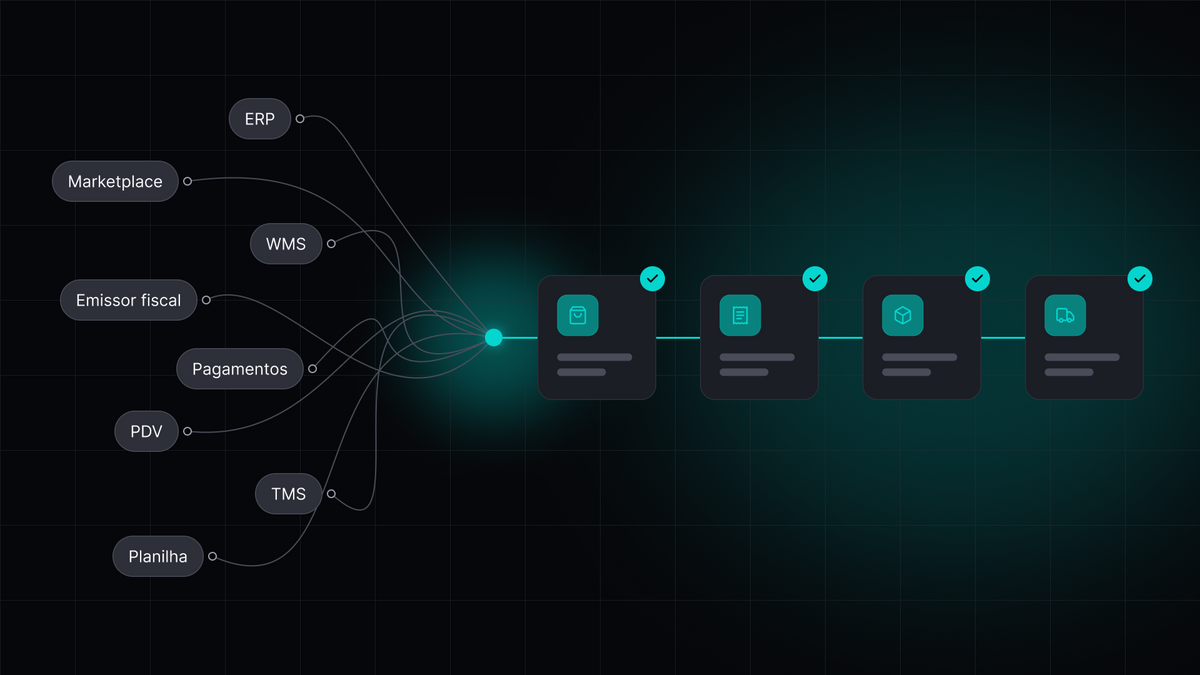
The End of Rivalry: The Rise of the Commerce Orchestration Layer
The smart choice is not "Shopify or TOTVS." The enterprise market now demands a Commerce Orchestration Layer. See how each pillar positions itself:
1. Architecture (The Design)
Real value has shifted from code construction to systems design. An efficient architecture defines Shopify as the customer-facing layer and TOTVS as the back-office engine. Without this design, you create infinite technical debt.
2. Integrations (The Execution)
Execution has become a commodity. The differentiator is how you connect Shopify to TOTVS through tools such as the approved apps from our Check Integrations division. This ensures that orders, inventory, and billing flow without human intervention, mitigating errors and increasing operational security.
3. Intelligence (The Decision)
Where most fail is in the "Decision Gap." The correct integration allows AI to analyze anomalies in real time, suggesting price, inventory, or shipping adjustments based on the data flowing between your ERP and your store.
When Does Each Solution Take Center Stage?
Prioritize Shopify When:
-
Speed to market and user experience are critical.
-
You need a DTC or B2B operation with optimized conversion.
-
The goal is to reduce the overhead of server maintenance and security.
Prioritize Integration with TOTVS When:
-
Tax complexity and omnichannel management are at the center of the operation.
-
There is total dependence on already established manufacturing or heavy logistics processes.
-
Corporate governance requires a robust market ERP.
Strategic FAQ
Does Shopify Replace TOTVS?
No. They serve different functions. Shopify governs the experience and the sale; TOTVS governs the process and compliance. They are complementary in a modern architecture.
Is It Difficult to Integrate Shopify with TOTVS?
Historically, yes. However, with the right orchestration layer and the use of modern APIs, our integration becomes the business's scaling engine, enabling exponential revenue growth with the same headcount.
What Is Check's Role in This Architecture?
Check is not a software factory. We are the Orchestration Layer. We design the architecture, implement the integrations, and provide the data intelligence so that your Shopify operation grows with absolute control.
Conclusion: Stop Building Stores, Start Orchestrating Systems.
If you are comparing these tools as substitutes, your strategy may be obsolete. The future belongs to Agentic Commerce, where technology works to boost your margins.
Need an architecture assessment to unite your TOTVS operation with the power of Shopify? Talk to the orchestrators at Check.