
E-commerce is growing, media is driving more traffic, and it is precisely at this moment that operations begin to stall. The website shows products that are already sold out, invoices are delayed, and orders get stuck between the store and the ERP. For those who make the business decisions, the symptom appears as lost sales and dissatisfied customers. The cause is almost always in the e-commerce system integration: in how the store, ERP, inventory, and tax systems communicate with each other.
This is the paradox of growth. Scaling requires connecting more and more systems to the store, such as ERP (SAP, Oracle, TOTVS), warehouse management (WMS), tax issuance, and CRM. If these connections are not designed to work together, what should accelerate operations becomes its main bottleneck.
When volume exposes flaws
With few orders, a fragile integration goes unnoticed. A synchronization that takes a few minutes makes no difference on an ordinary Tuesday, but it does during a collection launch, an influencer campaign, or Black Friday. It is in these moments that problems appear, and they usually appear together:
-
Stockouts: when the ERP takes too long to synchronize with the store, the website continues to sell products that are already sold out at the distribution center. The result is a canceled order, a return, and a customer who is unlikely to return.
-
Tax bottleneck: Brazilian taxation has rules that change by state, by CNPJ, and by type of movement. If invoice issuance depends on a manual process or a fragile integration, it stalls, and shipping stops along with it.
-
Slow website: dozens of apps running competing scripts in the cart make the page heavy, and speed directly impacts revenue. In the study Milliseconds Make Millions, conducted by Deloitte and by 55 at the request of Google with 37 brands from Europe and the United States, a 0.1-second improvement in mobile website speed increased retail conversion by 8.4%.
-
Manual work that grows with sales: order re-entered in the ERP, tracking code copied by hand, inventory checked in a spreadsheet at the end of the day. Each process is small, but they add up, and on peak days no team can handle it.
If your operation recognizes more than one of these signs, or if you have a launch, an opening, or a seasonal date ahead that the current structure does not seem prepared to support, the problem is unlikely to be the people. It is in the way the systems were connected.
From spaghetti integration to orchestration
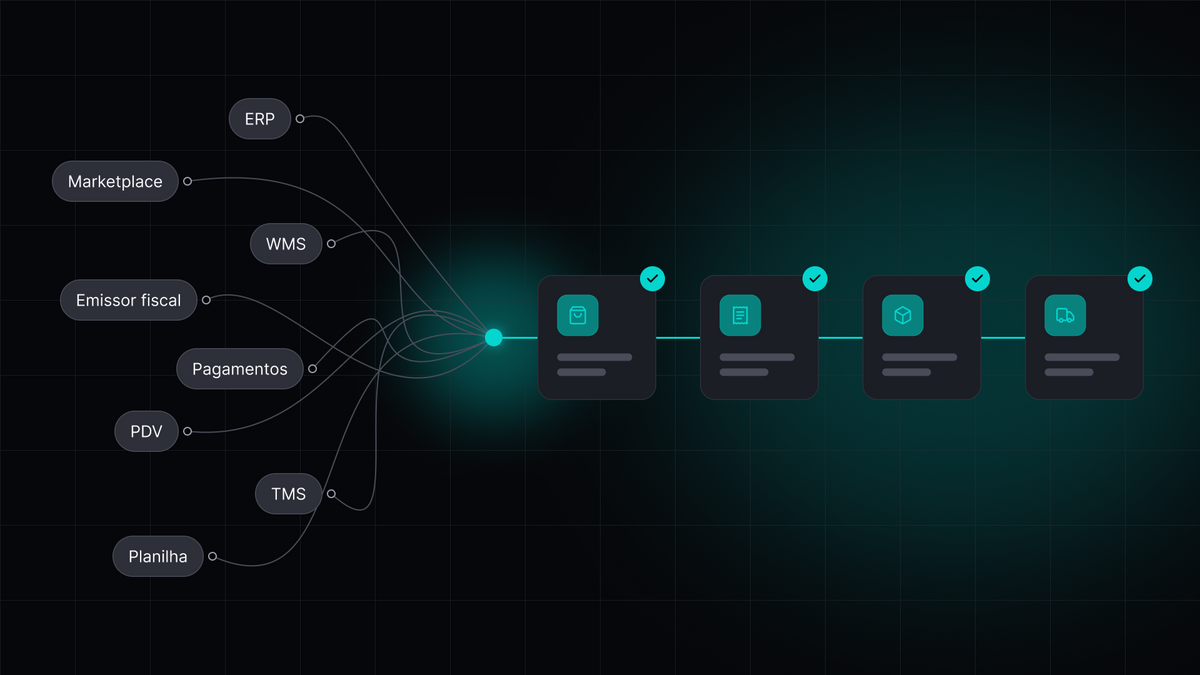
Most operations start by connecting each system directly to another, one by one: the store to the ERP, the ERP to the WMS, the store to the tax tool. This is what is called siloed integration, and for a small operation it works well. However, as the business gains channels, physical stores, and tools, the connections multiply and form what the market has dubbed "spaghetti integration": a network where no one has a view of the whole, and a change at one end can bring down the entire flow.
Larger operations need many systems, and that will not change. What makes a difference is having a central point that coordinates this flow. In system orchestration, instead of each tool talking directly to the others, a central system receives the order, distributes the information to each part of the operation, and monitors each step until delivery. In e-commerce, this role usually falls to the OMS, the order management system. In a Shopify store, for example, the integration with the ERP goes through the OMS, which receives the order as soon as it is created and forwards it to the tax issuer and logistics.
With this structure, the order follows from the click to delivery without manual work, and the failure of one system stops compromising the others.
What to evaluate in your e-commerce system integration
Integration seems like an exclusive IT topic, but the questions that matter are operational, and any manager can ask them to the supplier or the team itself.
The first is about contingency: what happens to the orders if a system goes down. Without a plan for this, an order placed during an ERP instability can be lost or require manual reprocessing. A prepared structure stores the orders, notifies the operation, and automatically reprocesses everything when the connection returns.
The second is about Brazilian tax: integrations standardized for other markets do not always cover ICMS by state, invoicing by multiple CNPJs, or transfer and return invoices. For those who sell nationwide, or move inventory between the distribution center, physical stores, and dark stores, this needs to be resolved within the flow, and not in manual workarounds.
It is also worth asking how long it takes for inventory to update between the channels, and asking for the answer in minutes, not in generic terms like "real time". In operations with a physical store and a website, the ideal is a unified inventory, which shows the customer the same availability on any channel.
Then, what happens when the integration you need does not exist. Regional ERPs, proprietary systems, and specific business rules do not always have a ready-made connector, and the difference is whether the structure adapts to the operation or the operation has to adapt to the tool.
Finally, visibility. Integration that works as a black box leaves the manager dependent on third parties to understand their own business. Knowing the status of each process, the deadlines, and who is responsible when something goes wrong is what transforms a technical problem into a problem with an owner and a deadline to be solved.
Build in-house or hire
Given all this, it is common for the company to think about developing the integrations with its own team. The decision depends on the size and focus of this team, but one point usually gets left out of the calculation: developing the integration is just the beginning. Each connection needs to follow the changes in the suppliers' APIs, be monitored against outages, and be updated when it becomes outdated, a continuous work that rarely enters the planning.
In lean technology teams, this maintenance tends to occupy the schedule that would be for the evolution of the store and the buying journey. In companies whose digital team is small or not technical, the question is usually another: who takes over when the integration stops in the middle of a campaign. Before deciding, it is worth measuring how much of the team's time already goes to maintaining what exists, and who is responsible when the problem appears.
Complexity is not a commodity
In 2011, Marc Andreessen wrote that software was eating the world. Since then, implementing a store or connecting a system has become faster and more accessible: execution became a commodity. Complexity, not. What separates the operations that scale from those that stagnate is the ability to make the store, ERP, inventory, tax, and logistics work as a single flow.
At Check Commerce, this is the work of the Integration Layer. When it is well done, the peak of a campaign stops being a risk and becomes just volume, and the team leaves the correction of flaws to go back to deciding what moves the business: assortment, channels, and customer experience.