
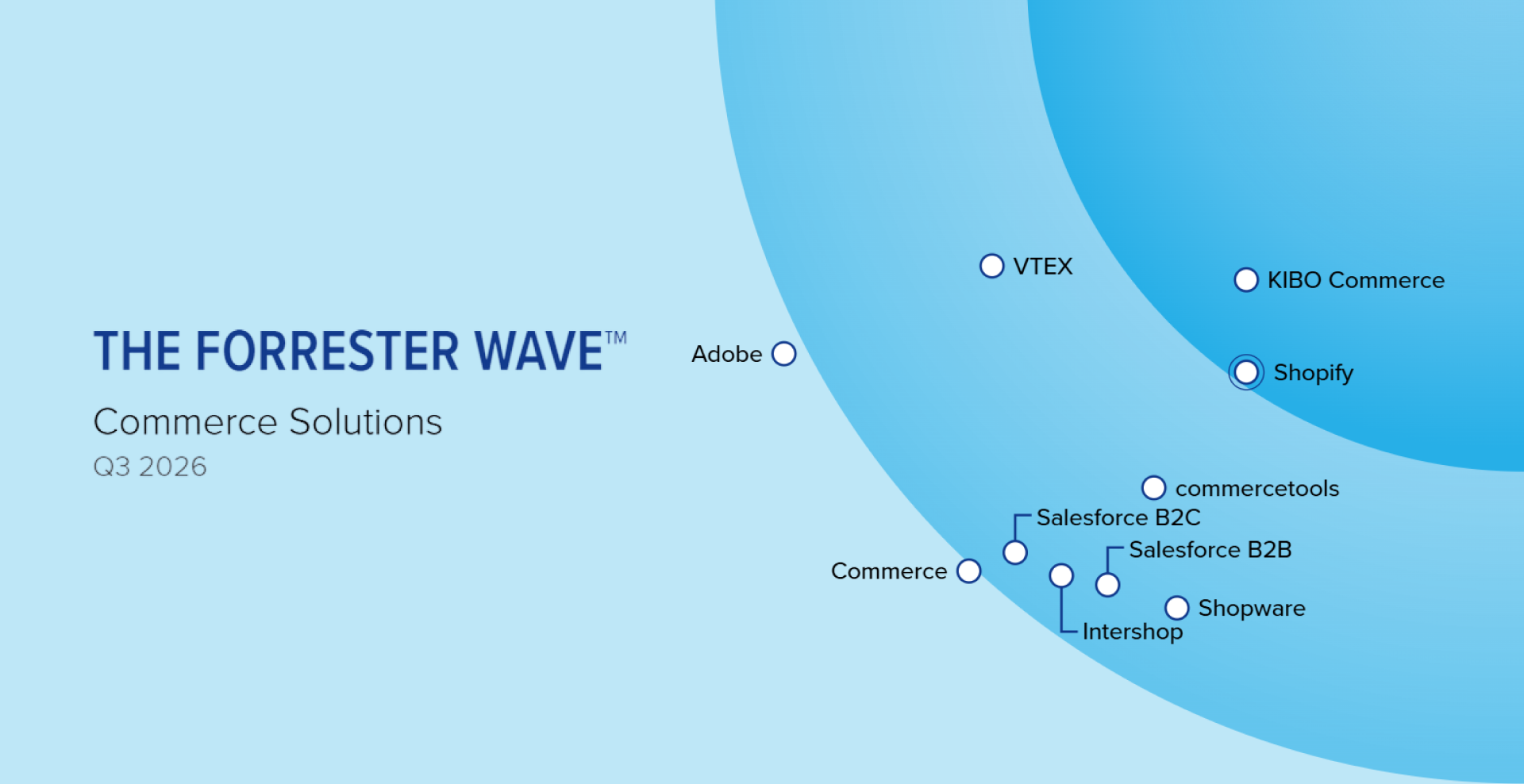
Forrester published the new edition of The Forrester Wave™: Commerce Solutions, Q3 2026 in July, evaluating some of the world's leading commerce platforms.
For the first time, the consulting firm brought B2B and B2C together in a single evaluation. And Shopify appears again among the Leaders, now competing in a much broader commerce analysis.
For those who still associate Shopify with a simple platform for small stores, the result is yet more evidence of a transformation that has been happening for several years.
But, for us, the most interesting point of the report is another.

Having more features doesn't necessarily mean having a better platform
For many years, the choice of an enterprise e-commerce platform was guided almost like a checklist.
Marketplace? Yes.
B2B? Yes.
Promotion Management? Yes.
OMS? Yes.
Personalization? Yes.
Selling in multiple countries? Yes.
The more boxes checked, the more complete the platform seemed.
The problem is that anyone who operates e-commerce every day knows that there is a huge difference between a feature existing and a feature being really good to use.
One platform may allow you to set up a collection in two minutes. Another may require spreadsheets, documentation, training, multiple screens, hard-to-understand rules, and eventually the involvement of a developer.
In the spreadsheet, both have "Collection Management".
In operation, they are completely different products. In one, collections are dynamic; in the other, they are static and require constant updating.
And the market itself is starting to realize this.
In the analysis accompanying the 2026 Wave, Forrester states that companies are increasingly concerned with simplification, cost management, and return on investment. The consulting firm also draws attention to platforms whose updates and changes end up generating so much operational effort that customers start considering migrating to another vendor. For example, changing the front-end technology.
This may be the most important point of the entire discussion.

Complexity is also a cost
The cost of a commerce platform is not just its license.
It is the number of people needed to operate it.
It is the number of developers needed to evolve it.
It is how long a campaign takes to go live.
It is how many systems need to be integrated.
It is how many hours are spent investigating why a certain configuration didn't work.
It is how much specialized knowledge needs to exist within the company just to keep the commerce running.
In other words: complexity is also part of the TCO.
And this is exactly where Shopify's product philosophy becomes particularly interesting.
Shopify itself defines its goal as transforming the hardest parts of building and operating a business into simple and powerful tools. That is why it was the only platform in the study that achieved a maximum score in user experience and usability.
This simplicity does not mean an absence of sophistication. It means hiding the complexity that the merchant should not need to manage.
From a simple platform to a global commerce infrastructure
This transformation did not happen overnight.
In 2024, in its first participation in Forrester's B2B-specific evaluation, Shopify had already been positioned as a Leader.
Two years later, B2B and B2C become part of a single analysis — and Shopify remains in the leadership group.
At the same time, the platform continues to expand its surface: B2B, POS, Markets, payments, extensibility, data, automations, and now an ever-growing layer of Artificial Intelligence and agentic commerce.
The interesting thing is that this expansion happens while preserving a characteristic that has always differentiated Shopify: making complex things seem simple.
For a large-scale operation, this has huge consequences.
Less proprietary infrastructure to maintain.
Fewer basic features that need to be developed internally.
Less technical dependency for business activities.
And more capacity to concentrate technology where it really differentiates the business.
The best platform is not necessarily the one that does the most
Forrester itself makes an important warning about the interpretation of its Wave.
According to the analyst responsible for the study, simply looking at who is higher and further to the right on the chart is not the correct way to choose a platform. The criteria that really matter depend on the needs of each business.
We agree.
A company should not only ask:
"Can this platform do this?"
It should also ask:
"How much effort will be needed to make this work well?"
And then:
"How much effort will be needed to keep operating this for the next five years?"
These are very different questions.
The more mature commerce technology becomes, the less sense it makes to evaluate platforms solely by the number of available features.
The next competition is for productivity.
Speed.
Autonomy.
Extensibility.
Maintainability.
And the ability to continuously incorporate new technologies without having to rebuild the operation every cycle.
This is why Shopify's result matters
Shopify's position among the Leaders of the 2026 Forrester Wave does not mean that it is automatically the best platform for any company.
No platform is.
But it reinforces something we have been following for years: Shopify no longer needs to prove that it can serve enterprise operations.
The discussion now is another.
It is about how much simpler it can be to operate a large company when a large part of the complexity of commerce ceases to be its responsibility and becomes the responsibility of the platform.
Because sophisticated technology should not necessarily produce sophisticatedly complicated operations.
Most of the time, the best product is precisely the one that absorbs the complexity.
And gives simplicity back to those who need to operate the business.
Best regards,
Érico Scorpioni.
Source: The Forrester Wave™: Commerce Solutions, Q3 2026 (Forrester Research, July 2026).