
Every e-commerce owner or manager has heard the same promise: there is an artificial intelligence (AI) capable of doing it all, from customer service to inventory forecasting. The problem is that this promise rarely holds up in practice, and betting your entire business on a single tool means handing over control of your operation to another company.
The debate in e-commerce usually revolves around a question that is far too simple: which is the best AI on the market? People argue about which assistant responds faster or which one should become the company standard. But anyone who cares about the business's margins already understands that this is not the right question. The risk is not in choosing the wrong tool. It is in depending on just one.
A warning from the leader of one of the world's largest technology companies
Satya Nadella, CEO of Microsoft, issued a direct warning to the market in July 2026: companies that hand over their entire operation to a single AI vendor may not survive. His reasoning is about control. Anyone who puts data, processes, and history into the hands of a single technology becomes dependent on that vendor's decisions and loses control over their own knowledge of the business. According to him, the solution is to maintain your own layer between the company's data and the AI models, so you can switch tools without losing control.
For anyone who runs a store, the lesson is practical: the sustainable growth of an operation depends on maintaining control of your own data and organizing the business so that multiple tools work together, each doing what it does best.
What your store loses when it depends on a single tool
When an e-commerce business concentrates all its important processes in a single assistant, any instability in that system or any change in that vendor's rules immediately affects sales. This type of dependency weighs heavily on three concrete fronts:
Errors due to a lack of specialization: a tool that is good at talking to customers is not as accurate at detecting a suspicious payment charge or forecasting product demand.
Data security risk: when all customer and company information is held by a single AI vendor, you lose control over who accesses what and become dependent on their rules to protect sensitive business data.
Difficulty keeping up with new developments: technology changes every week. A store tied to a single, closed system cannot incorporate new tools without rebuilding much of its infrastructure from scratch.
The competitive advantage in today's commerce belongs to the operation that organizes its data so that different tools work together, each within its scope and in a coordinated manner.
How this works in practice
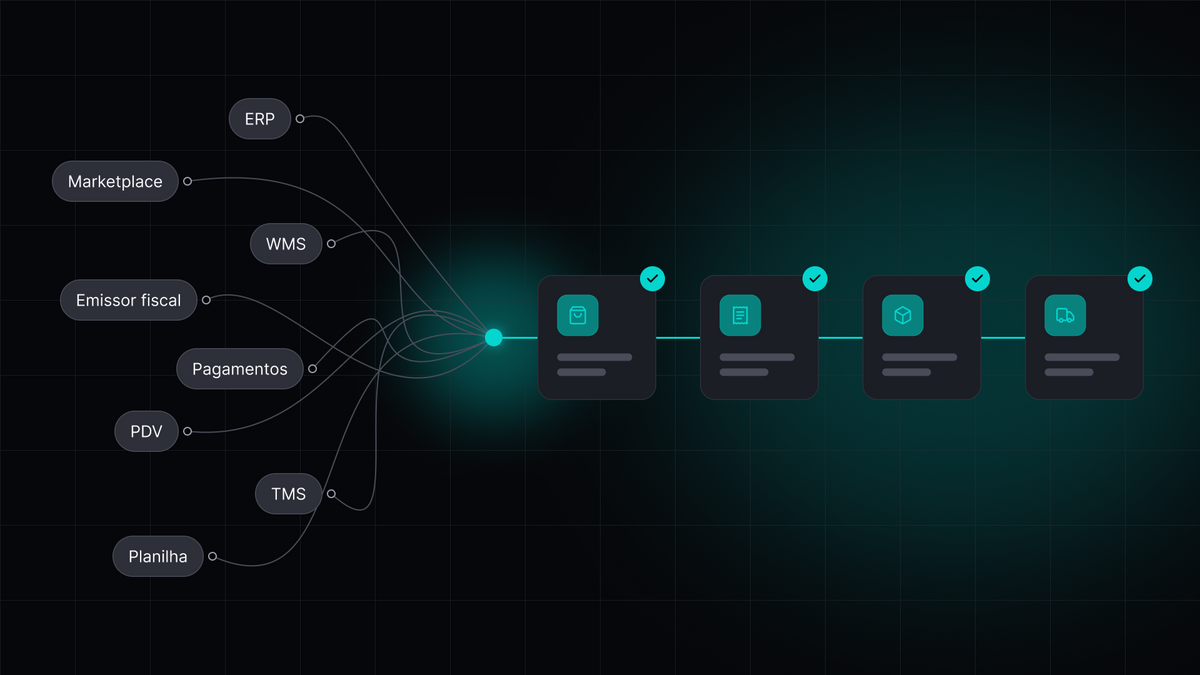
Coordinating different AI tools requires a real technical foundation: it is not just a concept. Without it, information remains scattered across spreadsheets, messages, and systems that do not communicate, and that is what stalls important decisions at the very moment they need to be made. This is the problem that orchestration solves.
Orchestrating artificial intelligence does not mean choosing a single tool and forcing it to do everything. It means the opposite: accepting that each assistant has a specialty and organizing the business so that these specialties work together, on the same database, without overlapping. One assistant may be great at predicting stockouts. Another may write a better response for the customer. A third may generate the right image for the ad. None need to be good at everything, because the operation does not depend on just one. It depends on how these pieces fit together.
At Check, orchestration means bringing the management of the operation together in one place and securely connecting the AI tools you choose to it. This place is the Check Platform, where you and our team manage the operation together: monitoring deliveries and results, opening improvement requests, and taking care of the store's maintenance and evolution. That is also where applied AI analyzes the data from your Shopify operation and flags anything that deviates from the norm, such as below-average conversion, more abandoned carts than expected, or website slowness. This entire structure is built and maintained by Check, so you do not need to integrate systems yourself or worry about keeping these connections working.
This connection goes through a technology that Check has already put into operation, the MCP Server: the gateway that provides authorized AI assistants with controlled and secure access to Check Platform data.
In practice, you consult your operation through whichever AI assistant you prefer. It retrieves the information, cross-references the data, and returns the answer with context and speed, seeing only what it has permission to see, without you having to export a spreadsheet or duplicate a registration. And if you ever want to switch assistants, the data remains yours.
More speed, with the decision in the hands of those who know the business
This coordination brings three concrete benefits to anyone who manages an e-commerce business. First, it facilitates human validation: instead of checking reports scattered across different screens, the manager receives the information already organized and ready to make a decision. Second, it reduces operational costs: less rework gathering data manually, fewer team hours spent correcting information that should have already been correct. Third, it anticipates problems: applied AI flags anomalies, such as a drop in conversion or a spike in abandoned carts, the moment they happen, before they become losses.
However, AI never decides on its own. Its role is to organize data that would otherwise be scattered, cross-reference information that would normally require hours of manual work, and suggest the most likely path, always displayed clearly, with the full context visible.
The final decision belongs to the e-commerce manager, with Check's specialists by their side, because they are the ones who understand the business's current situation, the customer's history, and what makes sense beyond what the data shows. Automating the collection and organization of information does not mean automating judgment. This is the distinction that makes the decision faster without making it less human.
None of these changes require stopping what is already working. Orchestration starts with the data your store already has and adds one tool at a time, testing which one does each part of the work best. If you are considering this path, we can talk about what makes sense for your operation.
Control remains yours.