
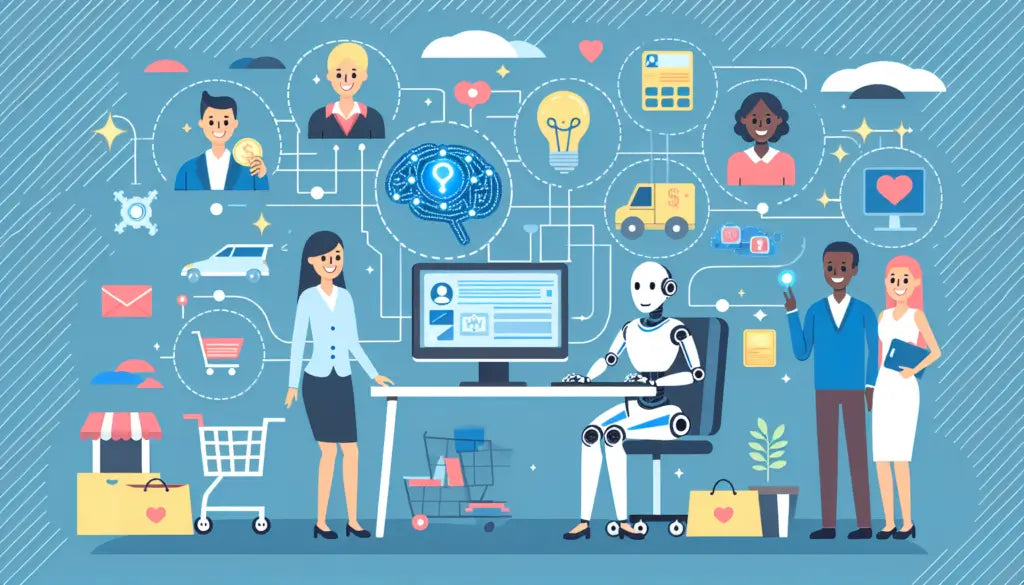
Artificial Intelligence (AI) plays a crucial role in the growth of the e-commerce sector, with Brazil's e-commerce market reaching R$ 185.7 billion in 2023 according to the Brazilian Association of E-commerce (ABComm). AI is a key factor in the attractiveness and profitability of e-commerce, allowing machines to learn from data and perform complex tasks autonomously or with human assistance 1. With consumer behavior changing due to digitalization, companies need to adapt to these changes to improve the customer experience 3.
This article will explore how AI can be applied to enhance the customer journey in e-commerce, from personalizing the shopping experience to optimizing delivery logistics and improving customer service. We will also discuss how an excellent customer experience contributes to customer retention, a crucial aspect given that the cost of acquiring a new customer is five to seven times higher than retaining an existing one 2.
Personalizing the Shopping Experience
Artificial Intelligence (AI) plays a fundamental role in personalizing the shopping experience in e-commerce. AI algorithms can analyze customers' purchase history, preferences, and browsing behavior to suggest relevant and interesting products 1. In addition, AI-powered voice and image search allow customers to find products more quickly and easily 1. AI also enables audience segmentation and the development of specific actions for groups or individuals, increasing performance 4.
AI-driven personalization includes:
- Personalized product recommendations based on user behavior, purchase history, and preferences 6 9 11 12
- Personalizing content and offers according to customer preferences, purchase history, browsing behavior, and other relevant data 6 9
- Personalized marketing messages, products, services, and relevant content 9 12
- Personalized user journey on the e-commerce homepage 9
- Relevant content, such as personalized offers, product recommendations, and personalized emails, based on anticipating customer expectations and behaviors 9
Generative AI allows for more refined segmentation and personalization, helping to create relevant experiences more quickly and with more context 7. Retailers can automate tasks and increase sales with product descriptions, smart promotions, and other GPT-generated services 7. In addition, digital concierges that help shoppers discover products allow for premium service at scale 7.
Optimizing Delivery Logistics
Artificial Intelligence (AI) plays a crucial role in optimizing delivery logistics in e-commerce, significantly improving delivery efficiency, reducing costs, and increasing customer satisfaction 17. AI can process large amounts of data in real time, allowing for the identification of the most efficient and cost-effective delivery routes 17. AI-based route optimization leads to faster deliveries, greater operational efficiency, increased driver safety, and greater customer satisfaction 17.
Some of the benefits of AI in delivery logistics include:
- Product demand forecasting and inventory level management, reducing waste and ensuring product availability 1 20 [22].
- Predictive analysis for demand forecasting, using machine learning algorithms to analyze historical sales data, user behavior, and other variables 6.
- Selecting the correct packaging for each product based on its weight and size, efficiently directing them to the correct trucks 19.
- Optimizing delivery routes, ensuring efficiency and speed, even in situations that require a second attempt 19.
- Providing customers with delivery status information, managing expectations, and avoiding frustration 18.
- Optimizing the use of resources such as vehicles, fuel, and labor, leading to significant savings for companies 20.
However, implementing AI in delivery logistics also presents some challenges, such as ensuring data quality, accuracy, and integrity, as well as integrating AI systems with existing management and tracking systems 17. The security and privacy of sensitive data during AI-based operations is also a critical concern 17. In addition, cultural and organizational acceptance of new technologies can present challenges, requiring proper training and communication to ensure successful adoption 17 20.
Improving Customer Service
Artificial Intelligence (AI) is transforming customer service in e-commerce, offering instant and personalized support to consumers. AI-powered chatbots and virtual assistants can interact with customers, providing information, support, and guidance 1. These computer programs automatically interact with customers, answering questions, providing product information, assisting with website navigation, and processing orders 6. In addition, they can communicate via text or voice messages, providing benefits such as reduced operating costs, greater availability, and improved customer satisfaction 1 2.
To meet consumer demands, companies need to transform digitally, focusing on proactive services, collaboration between humans and bots, workforce orchestration, and automation 3. Collaboration between AI and humans will revolutionize the way employees work, with more technology, services, and resources available 3. AI-powered real-time assistance helps agents in several ways, such as:
- Improving customer loyalty
- Reducing agent turnover
- Improving efficiency 3
In addition, empathy is essential for problem-solving and building meaningful connections with customers 3. AI-based sentiment analysis tools help organizations understand and engage with customers on an empathetic level 3. This allows companies to understand customer emotions and respond appropriately, strengthening relationships and improving customer loyalty 14.
How Experience Contributes to Retention
Artificial Intelligence (AI) plays a crucial role in customer retention in e-commerce, analyzing consumer data to provide valuable insights into preferences and purchasing habits 13. AI-driven sales strategies lead to improved results and a more satisfying customer experience 5. AI can adjust product prices based on market conditions and consumer behavior, increasing competitiveness, providing better value to the customer, and offering greater business flexibility 1.
In addition, AI can:
- Identify upselling and cross-selling opportunities, increasing the average transaction value 5.
- Analyze large amounts of data in real time, identifying patterns and trends that would be almost impossible to detect manually 5.
- Reduce marketing and advertising costs, being economical 2.
- Promote revenue growth, as repeat customers tend to spend more 2.
- Increase word-of-mouth marketing opportunities, as loyal customers share their experiences with others 2.
- Help understand future customer behavior by analyzing historical data 2.
- Identify early signs of customer churn and help formulate targeted strategies to retain high-risk customers 2.
- Analyze customer feedback to understand emotional responses and identify areas for improvement, innovation, and competitive advantage 2.
AI-powered customer retention programs generally include personalized and dynamic loyalty and rewards systems, further encouraging customer engagement and loyalty 14. The successful implementation of AI in customer retention strategies requires a data-driven approach, continuous monitoring, and adaptation to customer feedback and market trends 14. Successful companies invest in AI to retain customers 16, as it can help understand customer thoughts and feelings, allowing them to act promptly 16.
Conclusion
Artificial Intelligence has revolutionized the consumer experience in e-commerce, from personalizing the shopping journey to optimizing delivery logistics and improving customer service. By analyzing consumer data, AI provides valuable insights into preferences and purchasing habits, enabling enhanced sales strategies and a more satisfying customer experience. In addition, AI plays a fundamental role in customer retention, identifying upselling and cross-selling opportunities, analyzing customer feedback, and implementing personalized loyalty programs.
To remain competitive in the constantly evolving e-commerce market, companies need to embrace AI and its transformative applications. Discover Check Commerce solutions to elevate your customer's shopping experience and harness the full potential of AI in the consumer journey. By investing in AI technologies, companies can not only improve customer satisfaction but also drive revenue growth and strengthen long-term customer loyalty.
FAQs
What is artificial intelligence's contribution to product and service development? Artificial intelligence contributes significantly to increased productivity and cost reduction, providing support in decision-making and process optimization. In Industry 4.0, AI has various practical applications, such as predictive maintenance, inventory control, generative design, quality management, robotics, and loss minimization.
What does artificial intelligence mean, and how does it enhance the customer experience in e-commerce? Artificial intelligence (AI) is a technology that simulates human intelligence in machines, and in the context of customer service, it is essential for optimizing and automating support. Examples include self-service tools such as chatbots, which help reduce the workload of human agents.
How does artificial intelligence boost results in production and sales processes? Artificial intelligence boosts results in production and sales processes by analyzing customer data to identify patterns in preferences and behaviors. This enables the customization of products to meet consumers' individual needs, which increases satisfaction levels and strengthens their competitive position in the market.
How is artificial intelligence applied in marketing? In digital marketing, artificial intelligence can understand users' individual behaviors and interests to offer more suitable and relevant ads, responding more effectively to each person's needs.
References
[1] – https://pt.linkedin.com/pulse/o-impacto-da-intelig%C3%AAncia-artificial-mercado-de-e-commerce-nirvf [2] – https://cdp.solutions/pt/4-maneiras-ai-pode-contribuir-para-a-estrategia-e-para-retencao-de-clientes/ [3] – https://inovativos.com.br/experiencia-conversacional-o-papel-da-ia/ [4] – https://wake.tech/blog/dados-experiencia-consumidor/ [5] – https://ecommercerocket.com.br/como-usar-a-inteligencia-artificial-para-vender-mais-em-meu-e-commerce/ [6] – https://agencian1.com.br/impulsione-suas-vendas-com-ia-aplicada-ao-ecommerce/ [7] – https://www.salesforce.com/br/blog/ia-generativa-comercio-eletronico/ [8] – https://stoom.com.br/inteligencia-artificial-para-ecommerce/ [9] – https://www.ecommercebrasil.com.br/artigos/o-papel-da-personalizacao-de-ia-no-crescimento-do-e-commerce [10] – https://techbuzz.com.br/e-commerce-e-ia-personalizando-a-experiencia-de-compra/ [11] – https://exame.com/tecnologia/experiencias-de-compra-personalizadas-serao-o-segredo-para-o-sucesso-no-varejo/ [12] – https://luby.com.br/inteligencia-artificial/ia-no-e-commerce/ [13] – https://aeroagency.pt/a-importancia-da-inteligencia-artificial-ecommerce/ [14] – https://fastercapital.com/pt/contente/Inteligencia-Artificial-para-Retencao-de-Clientes-Como-a-IA-esta-revolucionando-as-estrategias-de-retencao-de-clientes.html [15] – https://blog.postmetria.com.br/o-papel-da-inteligencia-artificial-na-experiencia-do-cliente/ [16] – https://aodigital.com.br/inteligencia-artificial-2/ [17] – https://imlog.com.br/artigos/transformando-a-entrega-no-e-commerce-com-inteligencia-artificial/ [18] – https://www.ecommercebrasil.com.br/artigos/inteligencia-artificial-aliada-ao-setor-de-logistica-do-seu-e-commerce [19] – https://conteudize.ai/blog/news-feed/como-a-inteligencia-artificial-esta-revolucionando-a-logistica-de-entrega-no-e-commerce/ [20] – https://pt.linkedin.com/pulse/intelig%C3%AAncia-artificial-na-log%C3%ADstica-otimizando-willian-oliveira-sgt9f