


Case
Brasilata
From the production line to the digital shelf with Check Commerce's Integrations layer.

About the Brand
A Brasilata is one of Brazil's largest manufacturers of metal packaging: seven decades in operation, five factories (SP, RS, GO, PE, RJ), a presence in 15 countries, and a revenue of R$ 1.2 billion in 2025.
It is the type of industry that supports giant brands such as BASF, Danone, AkzoNobel, Sherwin-Williams, and Eurofarma, providing cans, buckets, and aerosols on an industrial scale.
Technology as a Turning Point
The shift from offset to digital printing is what made the new model possible. Minimum print runs suited for SMEs, faster setup, competitive turnaround times, and complete customization from digital files: for the first time, the industry could serve a market it had previously overlooked.
But technology alone does not create a channel.
Between 2017 and 2023, Brasilata tested and discarded five business hypotheses before validating the right model: an in-house sales team didn't work, pure B2C found no demand, customization without design support caused friction, and minimum order quantities still held back smaller customers.
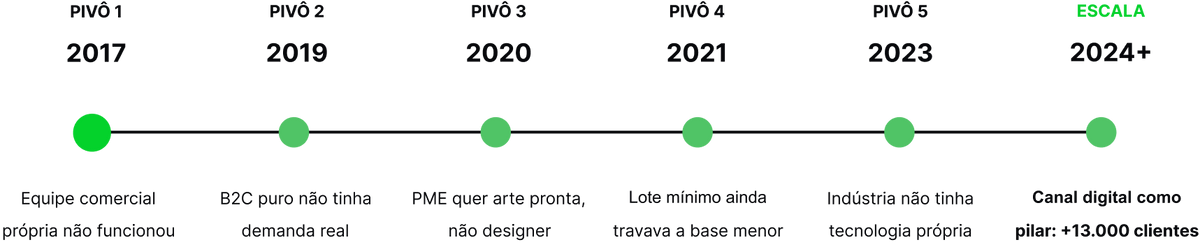
Each pivot taught a specific lesson, until the company realized that the real bottleneck wasn't industrial—it was the operating model.
The architecture behind the scale
The model that emerged from these learnings can only be sustained by a deliberate decision: keep the in-house team lean (four people) and outsource all specialized execution to partners who already do it at scale.

Custom Shopify Platform
with a shopping journey designed for an industrial buyer with no e-commerce experience.

Orders and fulfillment
The FullComm Omnichannel OMS & POS, our Shopify app, integrates the order from checkout to delivery, without its own logistics operation.

Customer Service
Outsourced, unified across chat, WhatsApp, and social media.
Manufacturing
Only production and shared services (finance, tax, and accounting control) remain at Brasilata.
Learning
Industrial e-commerce is not an IT project, it is a business model transformation: selling value instead of volume, pricing based on what the customer pays instead of markup on cost, treating a small customer as someone who needs a model to grow.
Loja da Lata proves that an established industry can have a D2C channel with real technical depth without sacrificing the scale that made it big.
Count on Check
If a company with seven decades of history managed to triple the value of its own operation, what can the right architecture unlock in yours?
Talk to a Specialist
